21/07/2026
For almost a decade, the doctrine of equivalents has been a powerful tool available to UK patentees. Following Actavis v Lilly, patent owners took comfort in the idea that competitors could no longer avoid infringing simply by making an immaterial change to a product.
However, the Court of Appeal’s decision in Salts Healthcare Ltd v Pelican Healthcare Ltd [2026] EWCA Civ 93 is an important reminder that this doctrine has limits.
The case concerned ostomy bags incorporating internal welded portions designed to improve the distribution of waste within the bag, reducing bulging and improving user comfort.
Salts alleged that Pelican’s ModaVi product infringed their patent GB2569212B both on a conventional interpretation of the claims and under the doctrine of equivalents. At first instance, the judge dismissed the infringement claim against Pelican and also found that independent claim 8, the relevant claim for the below discussion, was invalid for lack of novelty, and Salts appealed.
While the Court of Appeal concluded that claim 8 was valid, the judge upheld the finding of non-infringement and in doing so provided valuable guidance on both claim construction and the doctrine of equivalents.
A reminder of Actavis v Lilly
The Supreme Court held in Actavis v Lilly that a patent may be infringed by virtue of the doctrine of equivalents even if the product or process does not fall within the relevant claim(s) as a matter of interpretation. In order to determine this issue, Lord Neuberger said that the court should generally ask itself the following three questions:
(1) Notwithstanding that it is not within the literal meaning of the relevant claim(s) of the patent, does the variant achieve substantially the same result in substantially the same way as the invention, i.e. the inventive concept revealed by the patent?
(2) Would it be obvious to the person skilled in the art, reading the patent at the priority date, but knowing that the variant achieves substantially the same result as the invention, that it does so in substantially the same way as the invention?
(3) Would such a reader of the patent have concluded that the patentee nonetheless intended that strict compliance with the literal meaning of the relevant claim(s) of the patent was an essential requirement of the invention?
In order to establish infringement in a case where there is no literal infringement, a patentee would have to establish that the answer to the first two questions was ‘yes’ and that the answer to the third question was ‘no’.
At first instance, all three questions were answered “yes”, resulting in a finding of non-infringement.
We look at the answers to these questions provided in this Appeal below.
Claim wording still matters
Unusually, the patent in question included 10 independent claims, all of which defined an appliance comprising “weld portions”. However, only 5 of these, including claims 5 and 8 alleged by Salts to be directly infringed, defined that the weld portions “extend downwardly towards a bottom of the appliance”.
The issue central to infringement particularly concerned the claim requirement for a “first weld portion positioned to one side of the appliance… and which connects the first and second walls together, which first weld portion extends away from the periphery of the appliance and downwardly towards the bottom of the appliance“.
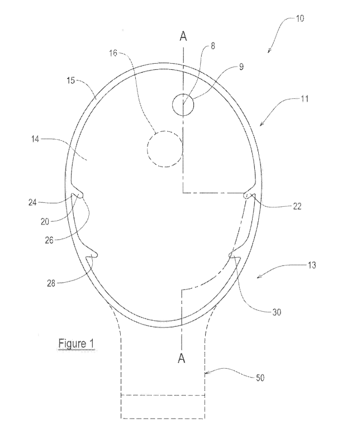
Figure 1 of the patent, reproduced below, illustrates weld portions 20, 22, 28 and 30
The downwardly angled weld portions help prevent bulging when the bag contains waste.
In contrast, Pelican’s ModaVi product incorporated “lobe” portions (reference numeral 16), illustrated below.
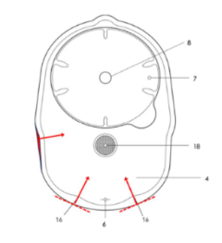
This Appeal upheld the first instance decision that the lobes of the closed ModaVi bag do not satisfy the requirements of weld portions that extend downwardly towards the bottom of the appliance because they extend upwardly, and therefore there was no literal direct infringement.
As such, at [62], the Judge states that the only issue is whether the lobes of the closed ModaVi bag “extend away from a periphery of the appliance and downwardly towards a bottom of the appliance” by virtue of equivalence. Only claim 8 (defining two weld portions) was then relevant, as claim 5 (defining four weld portions) further required the waist of the ModaVi bag to satisfy the above claimed requirement by equivalence, which was not asserted by Salts.
With the burden of proof on the Patentee, Salts showed that the variant (the lobes) achieved substantially the same result in substantially the same way as the claimed weld portions, and the Judge answered “yes” to question (1) above. It was not disputed that, if question (1) is answered “yes”, then so is question (2).
Regarding question (3), Salts argued that the skilled person would not understand the patentee to have intended strict compliance with the structural claim language.
The Court disagreed and this is where we are provided with further clarity on the application of this doctrine, the question being whether the skilled reader would understand that strict compliance with the above claimed feature required.
It was clarified that this is a question of interpretation of the specification, and not a factual issue on which either part has a burden of proof. Based on the wording of question (3) and particularly the word “nonetheless”, there must be a “good reason” why the skilled reader would conclude that strict compliance was required even though the answers to the first two questions are “yes”.
The Decision at [97] to [101] confirms that the Judge at first instance gave the correct answer to question (3) (“yes”) for four reasons:
- claim 8 is formulated in structural and not functional terms, and that the structural requirements are prescribed with considerable specificity;
- the relevant functional improvements claimed in the specification are only claimed for the specific weld portions 20, 22, 28, 30. The specification does not disclose any general principle, which appears to explain why the claims are closely modelled on the specific embodiments;
- there are a large number of independent claims, suggesting that the patentee carefully considered the extent to which the scope of the claims should extend beyond the specific embodiments and has attempted to cast the claims as broadly as possible; and
- claim 8 is limited to weld portions which extend downwardly towards a bottom of the appliance, whereas this is not a feature of other independent claims.
These “good reasons” show that the skilled person would have concluded that the patentee had intended strict compliance with the literal meaning of the claim wording, and it was therefore held that there was no infringement under the doctrine of equivalence.
It was held that extending protection of claim 8 beyond the specific structural language chosen by the patentee would exceed the fair protection afforded to the patentee and would not afford the reasonable degree of legal certainty owed to third parties. The structural limitations of the claims therefore remained decisive.
What can we learn?
The decision serves as a reminder that careful thought should be given to whether claims define an invention by structural features alone or whether broader functional language could more effectively protect the inventive concept.In the context of equivalents,when interpretingclaims defining specific structural language with “considerable specificity”, rather than functional language, we may now expect compliance with that structural language, reducing the chance that variants will be considered equivalent to claimed structural features.
Moreover, where some independent claims include such structural features which are omitted from others, it may be more difficult to argue that strict compliance with these features was not intended.
For applicants, this highlights the importance of ensuring that the claims and specification are properly aligned. Describing commercially relevant alternatives without claiming them may provide competitors with a legitimate route to the alternatives, beyond the reach of the doctrine of equivalents.
Anticipate design-arounds
With the above considerations in mind, applicants should continually ask during the drafting stage of their patent application: “If a competitor achieves the same clinical benefit using a slightly different structure, do our claims still cover it?“
If the answer is no, broader or alternative claim formulations may be needed.
Med-Tech competitors rarely produce identical copies of patented inventions or even competitor products. Instead, they typically develop products that deliver substantially the same clinical benefit while making modest structural modifications. Patent applications should therefore consider next-generation products, foreseeable engineering modifications, and manufacturing changes which all achieve the same technical effect.
Alongside this, the drafting process is often conducted while products such as medical devices are still in development. The evolving and iterative nature of clinical trials may mean that what is viewed as the “best” embodiment at the time of drafting may not ultimately be the version that succeeds or reaches the market. Patent specifications should therefore be drafted with this in mind to accommodate developments through the clinical trials process.
This further reinforces the benefit of including broader, functional language together with advantageous or commercially relevant examples when drafting the patent specification. Not only will this allow the protection initially sought to encompass the evolution of a product, but also helps to address issues highlighted in this decision – without disclosure in the specification of broader principles or examples, a court may treat specific claim features as essential.
Crucially, these considerations must be made during the drafting process and cannot wait until litigation. The dispute between Salts and Pelican demonstrates that successful patent enforcement often turns on decisions made many years earlier.
The decision provides an excellent opportunity for Med-Tech companies to review existing patent portfolios, and reflect on whether the claims protect foreseeable competitor modifications, as well as whether the portfolio will remain commercially valuable as products evolve over the next five to ten years.
Final thoughts
While the doctrine of equivalents remains an important aspect of UK patent law, it is not a reliable safety net for claims that fail to capture commercially important variants. For Med-Tech innovators, the decision is a timely reminder that careful application drafting remains the best tool for protecting innovation and preserving a competitive advantage.
This content is for general information only. Its content is not a statement of the law on any subject and does not constitute advice. Please contact Reddie & Grose LLP for advice before taking any action in reliance on it.