28/05/2026
This week Ferrari launched its first EV, the Luce. This marks a milestone in the history of the electric car. Ferrari is not new to the world of batteries and motors – their first hybrid, the LaFerrari, was launched in 2013 and the company has consistently offered at least one hybrid model since 2019. It has seemed inevitable for several years that Ferrari would eventually launch an EV; however, it feels remarkable that a manufacturer so renowned for its combustion engines has finally elected to produce a model powered by electricity alone.
The Luce marks a significant shift in strategy for the company. With the Luce, Ferrari are targeting a new, younger customer who is not necessarily concerned with the firm’s history or motorsport pedigree. This change is reflected in the car’s proportions and styling, which moves away from the low, exotic sports cars the company is known for, instead offering something closer to the shape of a crossover, somewhere between a coupé and an SUV. The car has been designed by LoveFrom, the design house led by Jony Ive (of Apple fame) and Marc Newson. Notably, Newson races his own vintage sports cars (including a Ferrari) but says he is not interested in new models. A change in designer at Ferrari has precedent. Since 1951 Ferrari outsourced exterior design work to the Italian firm Pininfarina, but they split in 2013, with Ferrari taking on the work themselves. However, Ferrari’s choice of designer for the Luce reflects the shift in strategy: they have opted for experience in consumer technology design, rather than cars.
We now know what the car looks like, but what will the car sound like? Without a combustion engine, the Luce will certainly sound like no Ferrari ever produced before. Indeed, since Ferrari are focusing on new customers who are not likely to be compelled by nostalgia for petrol and pistons, the Luce will require an innovative approach towards vehicle sound that goes beyond producing artificial engine noises, as some other manufacturers have done in their EVs.
Ferrari’s press release for the Luce gives us some clues towards their approach to sound. They say that the sound will be “authentic and functional, generated from the car’s mechanics and serving the driving experience”. The release describes a system involving an accelerometer at the centre of the axle that “captures the dynamic texture and vibration of rotating components”. The signal is filtered and amplified before being made audible, similarly to how an electric guitar works, as Ferrari claim. A number of recent patent filings by Ferrari give us a better idea of how this system might work.
EP4112384A1 appears to relate to the system described in the press release. EP’384 describes an acoustic system which includes a mechanical resonator (“reproduction device”) mechanically connected to an electric motor. An input signal is injected to the motor, which excites a resonant frequency of the resonator, producing a vibration and sound. The harmonic content of the input signal is configured to change as the electric motor’s speed changes. The patent application describes a further feature of allowing for the content of the input signal to ramp increasingly or decreasingly depending on the car’s acceleration. The input signal may also depend on vehicle conditions such as road roughness, an open or closed sunroof, the driving mode selected, and the driver’s driving style.
It is interesting that Ferrari have chosen for the sound to be produced by a vibrating resonant element, rather than the more straightforward choice of a digitally generated sound played through a loudspeaker. This should help to achieve a more natural, authentic sound, as sought in the press release.
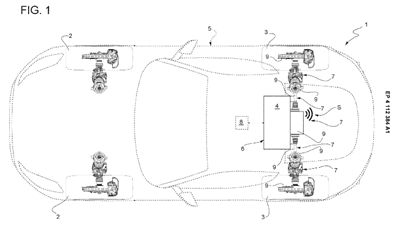
Figure 1: EP4112384A1
EP4520577B1 is a related patent describing a similar approach of injecting an input signal to an electric motor, which excites a mechanical resonator. However, in this system, the driver can shift between “virtual gears” while driving. Upon changing virtual gear, the system injects a signal, exciting the motor so as to provide an acoustic indication of a virtual gear change through the resonator.
The Luce press release does not explicitly describe these virtual gears. It talks about a “Torque Shift Engagement system”, which gives the driver control over power levels and engine braking levels with the right and left-hand gear paddles, respectively. Ferrari say, “the system does not simulate gear changes”, although it is reasonable to assume there could be a discrepancy between the language of a patent specification and a press release. On the other hand, Ferrari may have originally intended this virtual gear system to be for the Luce, and cancelled it, or may be reserving it for a future model, such as a more sports-oriented EV. We will have to wait and see.
EP4539038B1 provides a further approach to extracting sound from an electric motor. This patent describes a harmonic oscillator fitted with a magnet that is supported by an elastic element. The magnet interacts with the rotating magnetic field of the electric motor, which causes the oscillator to move. This produces a sound wave that corresponds to changes in the magnetic field of the motor. The patent application goes on to specify that the elastic element may be tubular and in a bellows form, and that more than one harmonic oscillator may be used, with each one having a different natural frequency. This can allow for different sound profiles to be produced according to different motor speeds. The harmonic oscillators may also be positioned at different angles, which can give a phase delay to the sounds produced.
The Luce press release promises “the utmost comfort of silence” when the car is set to a particular mode. EP4528716A1 describes an active road noise cancellation apparatus involving an actuator applied to or within an interior wall of a car. This appears to use a similar concept to noise cancelling headphones, wherein an adaptive filter produces a control signal to minimise the error between a desired reference sound and the interior noise.
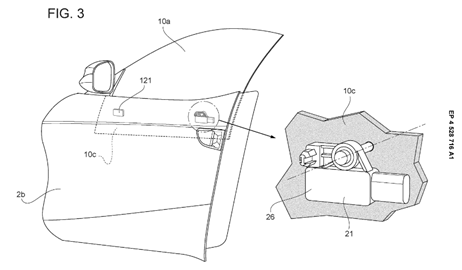
Figure 2: EP4528716A1
Whilst we cannot be certain which aspects of these patents and applications will be used in the Luce, they provide an interesting insight into how Ferrari intend to extract sound from typically silent electric motors, and the effort they are putting in to make these sounds natural and authentic.
This content is for general information only. Its content is not a statement of the law on any subject and does not constitute advice. Please contact Reddie & Grose LLP for advice before taking any action in reliance on it.