18/06/2026
BYD is the target of two infringement actions filed at the UPC by BMS Innovation LLC, a non-practising entity (NPE). The Chinese company has rapidly grown to become the world’s second-largest Li-ion battery manufacturer, as well as the world’s biggest seller of electric vehicles.
BMS Innovation is seeking to enforce EP3393001 (UPC-CFI-0002228/2025) and EP2937706 (UPC-CFI-0002070/2025), two LG Chem, Ltd. patents which appear to have been assigned, or to be in the process of being assigned, to BMS in Germany, France, and the UK.
A familiar experience for BYD
This is not the first time that BYD has been the defendant in an infringement action brought before the UPC by an NPE. In May 2025, BYD was alleged by Sol IP, LLC to have infringed standard-essential patents (SEPs) relating to cellular standards. Those UPC actions followed similar actions filed by Sol IP against BYD in national courts (e.g. before the Landgericht Mannheim).
Those cases were ultimately settled, with BYD understood to have taken an Avanci licence.
Why these cases differ
While the earlier infringement actions against BYD related to SEPs, the recently filed UPC actions relate to battery management system (BMS) inventions. They are not SEPs, and a negotiated outcome might be harder to achieve.
EP3393001 relates to the control side of a BMS, whereas EP2937706 relates to the mechanical connections of sensors for a BMS.
- EP3393001 was granted in 2021 and is a divisional application of EP2592684. It relates to a secondary battery management apparatus in which a “switch controller (27) is configured to measure the voltage of the high potential line (Pack+) through which the charge current or discharge current of the secondary battery (10) flows and, if the voltage is higher than a predetermined voltage level and the reception of a communication request signal transmitted at regular intervals is detected, the switch controller (27) is configured to transmit a turn-on signal to the power supply switch (28)”.
In other words, EP’001 relates to a BMS which relies on a two-factor wake-up condition – the power supply switch is turned on only when both a battery pack voltage threshold and a periodic communication request signal from the charger are detected. This may improve efficiency and reduce false activations.
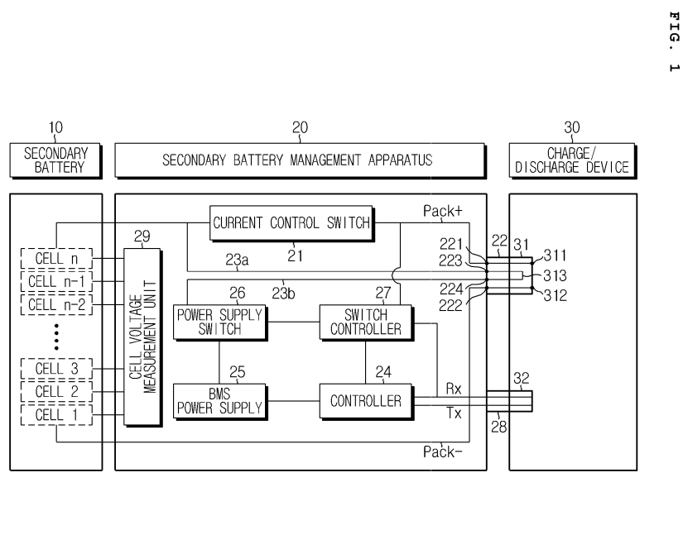
Figure 1 of EP3393001B1
- EP2937706 was granted in 2018. It relates to a battery module having a “voltage sensing member (500) for sensing voltage of battery cells constituting a battery module”. Claim 1 concerns how a plurality of conductive sensing parts of the voltage sensing member, the readings of which are transmitted to a BMS, are mechanically coupled to electrode terminals of the battery module and to the cover of the battery module – particularly, one end of each conductive sensing part “is provided with one or more fastening holes (512), through which each of the conductive sensing parts (512, 514, 516, 518) is fixed to the cover of the battery module.”
Simply put, EP’706 relates to the mechanical and electrical interface between sensing parts of a voltage sensing member and electrode terminals and the battery module cover, to provide surface-contact conductive sensing. This may provide improved mechanical and electrical reliability compared to less robust connections.
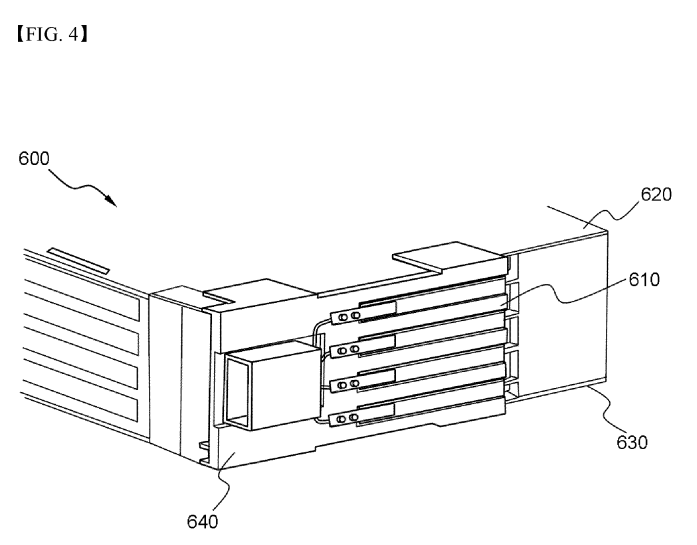
Figure 4 of EP2937706B1
The wider context of the UPC and patent litigation in the battery sector
Whatever the outcome of the actions brought against BYD by BMS Innovation, the UPC appears to be becoming an important enforcement venue for the battery sector. NPEs are playing their part. For example, previous infringement actions brought by Tulip Innovation (an LG and Panasonic-backed patent pool) reportedly leading to injunctive relief affecting sales and imports of the Dacia Spring because of its use of infringing Sunwoda batteries.
We have previously discussed the increasing importance of the UPC to NPEs.
NPEs are not the only entities in the battery sector using the UPC for enforcement:
Solvay is seeking to enforce one of its binder patents (EP2147029B1) against various Chinese suppliers before the Munich Local Division, and Philips has obtained wide-ranging injunctive relief against Belkin based on its wireless charging patent EP2867997. It has been noted that the UPC’s decision on EP’997 conflicts with a German court decision in Belkin’s favour.
What this means for battery-sector patent strategy
The UPC is proving to be an important venue for patent enforcement – decisions are delivered relatively quickly, rulings apply across national borders, its long-arm jurisdiction may, in some circumstances, extend to countries not part of the UPC agreement, and the UPC offers strong injunctive relief. The UPC is making independent decisions, even if there is a contrary national court decision.
Against the backdrop of the UPC’s emergence as an increasingly important forum for the battery sector, one strategic feature stands out in the enforcement landscape: the comparatively limited level of EPO opposition activity.
EPO oppositions offer a powerful mechanism for centrally challenging European patents across all designated states. The EPO is well known for its strict approach to added matter, making added-matter attacks particularly powerful in opposition proceedings. Despite these advantages, EPO oppositions appear to remain underutilised in the battery sector. For instance, neither of the two patents being asserted against BYD was opposed.
As battery-related patents are increasingly being asserted before the UPC and other European courts, opposition proceedings may become an increasingly important defensive tool for companies seeking to mitigate litigation risk at an early stage.
Meanwhile, the UPC looks set to remain a key forum for patent enforcement in the battery industry. We will follow the UPC actions against BYD closely.
This content is for general information only. Its content is not a statement of the law on any subject and does not constitute advice. Please contact Reddie & Grose LLP for advice before taking any action in reliance on it.