29/04/2026
The solar energy industry has seen extremely rapid development over the past two decades. In its early stages, innovation was primarily driven by improvements in photovoltaic (PV) module efficiency, enabling reliable and scalable electricity generation. This was followed by a second phase focused on cost reduction through economies of scale, manufacturing advances, and deployment optimisation. As a result, solar power has become one of the most economically competitive forms of electricity generation, with costs in many regions now comparable to, or lower than, those of fossil fuels [1].
However, as Si-based photovoltaic technologies approach their theoretical efficiency limits, the scope for further gains in power conversion efficiency has become increasingly constrained. This has contributed to a shift in innovation focus away from purely generation efficiency and towards system-level optimisation and integration.
This rapid technological and economic progress has led to a significant acceleration in solar deployment, both in the UK and globally. However, whilst these developments have largely addressed the challenges associated with generating solar power, they have also introduced a new set of issues relating to how that power is managed once generated.
Solar power’s temporal characteristics
Solar power is inherently dependent on environmental conditions. In other words, electricity generation from PV systems peaks during daylight hours and falls to near zero at night. In addition, output is highly sensitive to weather conditions and seasonal variation.
As the penetration of solar power within electricity grids increases, the impact of these characteristics becomes increasingly significant. In particular, large volumes of electricity are often generated simultaneously during relatively short periods, especially under conditions of high irradiance. This can result in periods of oversupply, where generation exceeds local demand or grid capacity.
Impact of oversupply on solar economics
The consequences of such oversupply are already observable in several mature electricity markets, including the UK. In particular, increasing penetration of renewable generation has led to more frequent periods in which wholesale electricity prices fall to very low or even negative levels. These conditions typically arise when high renewable output coincides with low demand, highlighting the growing mismatch between generation profiles and consumption patterns.
One common outcome is the curtailment of solar generation, whereby output is deliberately reduced despite the availability of sunlight. Grid constraints can further exacerbate these effects, limiting the ability of generators to export electricity. As a result, the economic performance of solar installations is increasingly influenced not only by how much electricity is generated, but also by when it is generated.
This is a fundamental shift in the solar energy landscape as, whilst earlier phases of development focused on maximising generation efficiency and reducing cost per unit of electricity, the current challenge also lies in aligning generation with demand and market conditions.
One of the primary solutions being deployed to address this challenge is the integration of battery energy storage systems (BESS) with large-scale solar installations. By storing excess electricity generated during periods of low demand and discharging it during periods of higher demand or elevated electricity prices, such systems enable a degree of temporal decoupling between generation and consumption.
This approach can reduce curtailment, improve the utilisation of generated energy, and enhance the overall economic performance of solar assets. It also allows operators to participate more effectively in electricity markets, including balancing and ancillary service markets.
The increasing importance of storage in addressing these challenges is reflected in the rapid growth of battery energy storage deployment. In the UK, operational battery storage capacity has expanded significantly in recent years, exceeding several gigawatts of installed power capacity and demonstrating substantial year-on-year growth. This expansion is expected to continue, supported by a strong pipeline of new projects and increasing demand for grid flexibility services [2][3][4].
However, whilst storage introduces flexibility, it does not in itself determine how energy flows should be optimally managed.
Optimising solar and storage systems
Effective operation of integrated solar and storage systems depends on how energy flows are managed between generation, storage, and the grid. In practice, this involves determining whether electricity should be exported immediately, stored for later use, or withheld to reserve capacity for future opportunities.
Such decisions depend on a wide range of dynamic and interrelated factors, including short-term forecasts of solar generation based on irradiance and weather data, electricity price signals from day-ahead, intra-day, and balancing markets, and battery-specific considerations such as state of charge, charge and discharge limits, and degradation behaviour. Grid-related constraints, including export limits and network congestion, along with system-level characteristics such as inverter efficiency, power conversion losses, and DC- or AC-coupled configurations, further influence performance. Balancing these elements requires optimisation across multiple key performance indicators, including maximising revenue, reducing curtailment, and preserving battery lifetime, making this a highly complex control problem, particularly for large-scale or distributed energy systems.
To address this complexity, solar and storage systems are increasingly operated using advanced energy management systems that coordinate PV generation, battery storage, and grid interaction through control algorithms integrating forecasts and real-time data. Predictive control approaches anticipate future conditions, while real-time optimisation responds dynamically to changing system states. At a broader level, distributed systems can be aggregated through virtual power plant architectures to enable portfolio-level optimisation. As a result, the performance and value of solar and storage systems are increasingly driven by the effectiveness of control strategies rather than generation capacity alone, reflecting a wider trend towards data-driven digitalisation in the energy sector
Innovations and patent landscape
The shift towards digitally optimised energy systems is also reflected in recent innovation and patent filing trends. In particular, there has been increasing activity in technologies relating to the control and operation of integrated solar and battery systems.
For example, international patent application WO2020160369A1 (General Electric Company) describes a method for controlling the charging and discharging of battery energy storage systems within a power grid, based on forecast renewable generation, demand profiles, and system constraints. Such approaches enable dynamic optimisation of energy flows in response to both generation variability and market conditions.
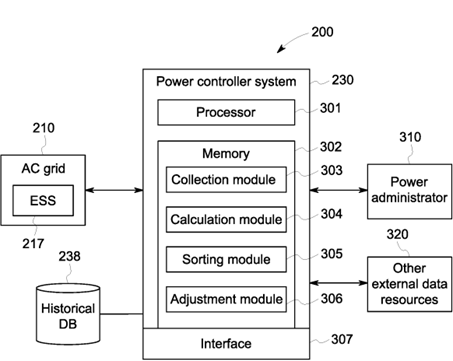
US20190036340A1 (Florida State University Research Foundation, Inc.) also discloses optimisation techniques for distributed energy resources, including photovoltaic systems and energy storage, using forecast data to coordinate supply with demand across a network of assets. This reflects the increasing importance of system-level optimisation in environments with high renewable penetration.
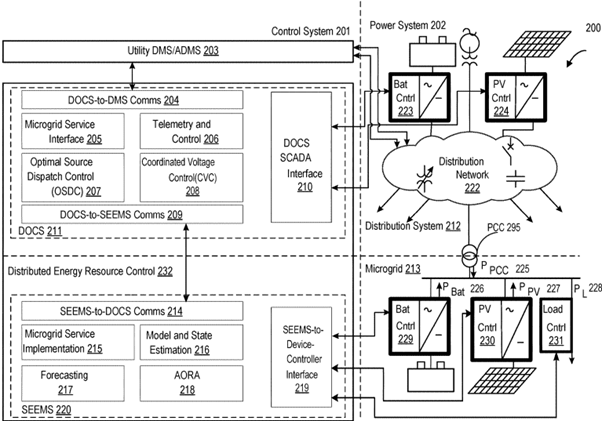
At the level of integrated plant operation, US20220294231A1 (GE Renewable Technologies SAS) describes control architectures for hybrid power plants incorporating solar generation, battery storage, and other generation assets. The system adjusts operation based on grid conditions such as demand, frequency, and voltage, illustrating the role of coordinated control in maintaining grid stability. In addition, US11387654B2 (University of California San Diego) relates to distributed control systems for battery energy storage coupled to photovoltaic installations, including coordinated charging, discharging, and reactive power management. Such approaches highlight the increasing sophistication of control strategies at both local and system-wide levels.
These examples suggest increasing importance of technologies for managing the interaction between generation, storage, and the grid, which is in line with the broader transition within the solar sector from a focus on energy generation to energy management and optimisation.
Patent protection for solar – storage control technologies
Whilst algorithms and business methods are not patentable in isolation under UK and European law (that is, they are excluded “as such”), inventions that apply such methods in a way that produces a technical effect may nevertheless be eligible for protection. In particular, control methods and systems that improve the operation of BESS systems, manage power flows between solar installations and the grid, or enhance system efficiency or stability may be considered to solve a technical problem, and hence considered patentable in the UK and Europe.
At Reddie & Grose we have extensive experience drafting and prosecuting patent applications covering commercially important technological developments, ensuring that our clients are provided with high quality patents, which adequately protect their inventions. If you have an invention in the fields of solar energy or battery storage system, or would like more information, please contact one of our team.
This content is for general information only. Its content is not a statement of the law on any subject and does not constitute advice. Please contact Reddie & Grose LLP for advice before taking any action in reliance on it.
References
[1] IRENA, “Renewable capacity statistics 2026,” 2026
[2] RenewableUK, “EnergyPulse – Stacking up the storage: where the UK battery market stands in 2025,” 2025
[3] Energy Storage News, “UK Battery Storage Project Database Report,” 2025
[4] Modo Energy, “GB Battery Pipeline Report: Operational capacity to hit 15 GW in 2027,” 2024