08/07/2026
The dispute between US drag performer and environmental activist Pattie Gonia and outdoor clothing brand Patagonia Inc. has hit the media by storm in recent weeks. After several years of co-existence, Pattie Gonia’s decision to file a trade mark in the US seems to have been a step too far in advocating her environmental cause. One may be surprised to learn that Patagonia Inc. have filed a lawsuit against a fellow climate activist. However, the company seeks only $1 plus legal fees in costs, suggesting the case is not financially motivated, but is instead deemed necessary for protecting the Patagonia brand. There is history between these parties.
The line between parody and infringement
A stage name is a drag performer’s central brand. As we discuss in articles here and here, it underpins both their public identity and their ability to expand into other industry sectors through merchandise and franchising. Parody and innuendo are two fundamental aspects of drag. However, the present dispute illustrates how using drag names that parody well-known brands is not without risk. The same liability for trade mark infringement applies, as it would to any brand; this is something drag performers should consider if they want to build a future-proofed persona.
Anyone who has been following the dispute online will know that it has exploded in publicity. With both sides sharing open letters and legal documents online, the dispute is as much a legal matter as one of public opinion.
Pattie Gonia, whose real name is Wyn Wiley, entered the drag scene in 2018. Since then, she has become a prominent environmental advocate, using her drag performances across the US to discuss climate change and co-founding the nonprofit The Outdoorist Oath to raise almost $4 million for charity.
The lawsuit filed by Patagonia Inc. in January 2026 was purportedly prompted by Pattie Gonia’s application to register PATTIE GONIA as a trade mark in the US in September 2025. The PATTIE GONIA application covers a range of goods and services spanning clothing, promotion of environmental sustainability, LGBTQIA2S+ equality and organisation of hiking events. Patagonia Inc. claims the application reflects Pattie Gonia’s “departure from discrete use of a persona to engage in activism and confirms [her] intent instead to launch a wide-ranging commercial enterprise”. Moreover, they argue that these goods and services compete directly with the products and advocacy on which Patagonia Inc. has built its brand for the past 53 years and would therefore confuse customers.
A breakdown of understandings and agreements
According to Patagonia Inc.’s lawsuit, in 2022 the parties “reached an understanding” in which Pattie Gonia agreed not to sell PATTIE GONIA-branded products or use fonts or designs similar to Patagonia Inc.’s logos, which are protected by trade mark rights dating back to the 1980s. Pattie Gonia’s subsequent sales of clothing branded with her name (pictured below) and trade mark application in 2025 are seen by them as a “contradict[ion]” of her “prior promises”.
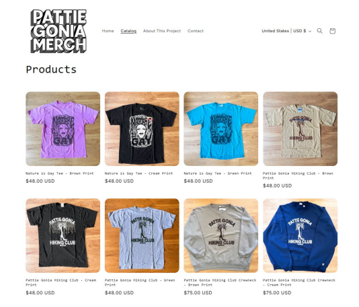
Image sourced from the lawsuit filed by Patagonia Inc.
However, the 2022 email chains published online by Patagonia Inc. show that Pattie Gonia’s agreement to this “understanding” was rather vague. There is no legal or binding contract, and therefore the extent of her commitment to cooperation is up to interpretation..
Commercial crossovers and consumer confusion
It can be challenging for brand owners to strike the right balance when combatting parodic use of their brand by third parties. If they are too aggressive, they risk generating public backlash that could be equally damaging commercially. Perhaps for this reason, brand owners are looking at this from a commercial angle. For example, we have seen the rucksack brand JanSport collaborate with drag performer Jan Sport to produce a bag line.
However, when a stage performer’s merchandise becomes divorced from their stage act, parodic names can become an issue.
This appears to be a central concern in Patagonia Inc.’s lawsuit. Patagonia Inc. seem wary that any goods or services branded with PATTIE GONIA could become disassociated from their real commercial origin, the drag performer Pattie Gonia. Consumers could mistakenly believe that they are sold by or in collaboration with Patagonia Inc. Therefore, from Patagonia Inc.’s perspective, they are trying to prevent consumer confusion about the origins of the products. This follows on from action the brand has taken in the past against names such as PETAGONIA, PETROGONIA and FRATAGONIA. Their decision to treat Pattie Gonia no differently despite her being a fellow environmental activist has demonstrated that careful measures to avoid reputational damage are vital.
What comes next?
For Pattie Gonia, it will be interesting to see what the dispute’s outcome means for her brand going forward. Since the filing of the lawsuit, she has already changed the name of her website’s merchandise page to PATTIE MERCH. We have seen how drag performer Trixie Mattel dropped ‘Mattel’ from her name when extending her brand through merchandise and a motel chain.
Whichever side of the dispute you support, the key takeaway is that there are always risks involved with referencing other brands in your brand name. If found, infringement is infringement, regardless of whether it takes the form of a parodic stage name!
This content is for general information only. Its content is not a statement of the law on any subject and does not constitute advice. Please contact Reddie & Grose LLP for advice before taking any action in reliance on it.