
02/04/2026
Indoor golf has undergone a remarkable transformation over the past decade, evolving from a basic practice aid into a sophisticated technological ecosystem that is reshaping how the game is played and experienced. What was once limited to simple nets and rough estimations of ball flight has become an immersive, data-driven environment capable of replicating real-world golf with striking precision. At the centre of this evolution lies a convergence of advanced hardware, sophisticated software, and increasingly intelligent data systems.
The foundation of indoor golf is the simulator, a system designed to recreate the experience of hitting a golf shot on an actual course. When a player strikes the ball into a screen, a network of sensors immediately captures critical data at the moment of impact. This data is then processed in real time and translated into a virtual ball flight that appears on a projected or digital display. The seamlessness of this process is what gives modern simulators their realism, but it depends on several layers of technology working together in harmony.
Modern systems are capable of capturing the precise moment a club strikes a ball and translating that interaction into a fully realised virtual shot. This begins with ball tracking technology. High-speed cameras or Doppler radar systems measure key variables such as ball speed, launch angle, and spin rate within milliseconds of impact. Even though the ball may only travel a few feet before hitting a screen, the system can calculate its entire flight path with remarkable accuracy.
The Rise of Indoor Golf
The increase in popularity of indoor golf is also reflected in participation data. Recent figures show that more people globally are now engaging with golf in off-course environments than on traditional courses[1]. In the United States, for example, the United States Golf Association reported that there were more off-course participants (32.0 million) than on-course players (26.6 million) for the first time in 2023. In South Korea, where there is relatively limited terrain for golf courses compared its population, ‘screen golf’ surpassed outdoor play nearly a decade ago, with a vast network of simulator venues supporting a thriving competitive scene. Today, millions of rounds are played annually on systems developed by companies such as Golfzon.
The rise of indoor golf is reflected in the related patent publications.
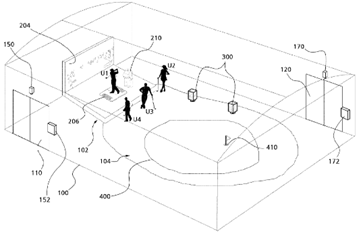
Figure 1: WO 2025/249774 A1
As an example, WO2025249774A1 is a PCT application filed by Golfzon directed to a hybrid course system and a golf game operating method which enables golf teams to proceed through the hybrid golf course seamlessly for smooth rounds without waiting. You might imagine that a patent filing such as this is a rare departure from the typical golf related patent filings for golf equipment such as golf balls and clubs. However, as shown below patent publications for electronic technology for golf applications has, in fact, surpassed patent publications for golf balls over a decade ago!
Growth has been driven not only by realism but also by the integration of data and connectivity. Platforms developed by companies like TrackMan have transformed simulators into part of a broader digital ecosystem. Every shot can be recorded, analysed, and stored, allowing players to track their progress over time and share data across devices and locations. Simulators and tracking systems have allowed coaching to become more precise and personalised, with instructors able to access detailed performance metrics and tailor their guidance accordingly.
At the same time, companies such as Toptracer have introduced a more playful dimension to the experience. By combining ball-tracking technology with gamified elements inspired by mobile gaming, they have made golf more engaging for younger audiences. This blend of sport and entertainment is a key factor in attracting new players, many of whom might never have considered picking up a golf club otherwise.
Patent Statistics
A keyword search of ‘Golf’ along with CPC classifications A63B 24/00 (Electronic controls for exercising apparatus); A63B 53/00 (Golf Clubs); A63B 37/00 (Solid balls); has produced patent publication data which has been collated in the following graph.
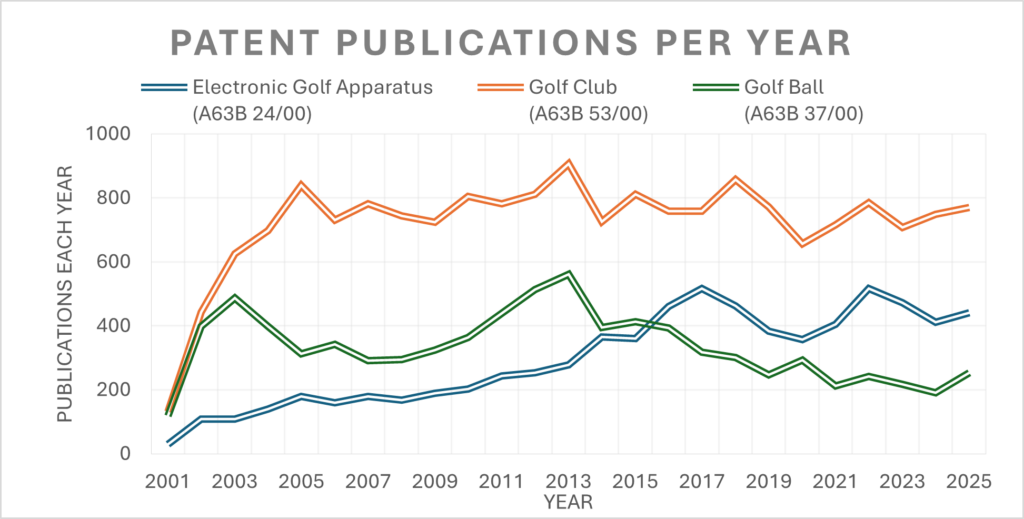
Figure 2: Graph of Patent Publications for Different Categories of Golf Technology
From the graph it is plain to see that the main area for innovation in golf is in the clubs themselves. This, of course, will not come as a shock – you wouldn’t be able to play much golf (indoor or outdoor) without a club or two. A typical player’s golf bag will contain a variety of different clubs for different areas of the course; namely woods, irons, wedges, and a putter. Therefore, a plethora of avenues for innovation exist for golf clubs, ranging from ways to increase distance and spin to increasing the sweet spot of a clubface.
Interestingly, about a decade ago the number of patent publications for electronic golf technology such as simulator technology surpassed the number of patent publications for golf balls. From around 2015 towards the present day, that gap has generally grown. On the face of it, this is perhaps surprising since golf balls, like golf clubs, are essential to golf play. However, the scope for innovation with golf balls is limited compared to golf clubs. A golf ball is a relatively simple design that is unlikely to change. We are unlikely to see a departure from the dimple pattern a since it is the optimal surface arrangement from an aerodynamic perspective. The main improvements to golf balls now mostly arise from materials innovation. Conversely, although golf simulator and tracer technology has already reached an impressive level of sophistication, its trajectory suggests there is still significant room for innovation. As the industry grows, future developments are likely to centre on realism, accessibility, connectivity, and intelligence. Crucially, many of these innovations are already being identified and protected through patents.
Developments
Developments in the golf simulation and tracer area have focussed on sensor fusion techniques, where algorithms combine inputs from different devices to produce a unified model of the swing and ball flight. These innovations are particularly valuable because they are difficult to replicate without infringing on proprietary methods. Future developments could include real-time 3D trajectory visualisation from multiple perspectives, integration with wearable devices, or even personalised visual overlays that highlight optimal shot shapes.
Final Remarks
Indoor technology is not necessarily replacing traditional golf, but it is complementing it by offering an alternative format that fits modern lifestyles. Data suggests that a significant majority of traditional golfers have now engaged with alternative formats, whether through simulators, driving ranges, or shorter forms of the game. For many, indoor golf serves as an entry point, lowering barriers to participation and eventually leading players onto the course.
Looking ahead, the trajectory of indoor golf technology suggests continued growth and innovation. Advances in artificial intelligence are beginning to enhance swing analysis, while improvements in hardware are making systems more compact and affordable. The integration of mobile devices, cloud platforms, and wearable technology will further deepen the connection between players and their data.
It is doubtful that indoor golf will globally surpass outdoor golf in popularity. What is clear, however, is that indoor golf is no longer a sideshow. It is a booming business and a technologically sophisticated, rapidly expanding dimension of the sport – one that is reshaping how golf is played, experienced, and understood in the modern era.
At Reddie & Grose LLP, we’re passionate about both IP and sport. Whether you’re designing the next generation of sports equipment or developing embedded technologies, our attorneys are on hand to help protect your innovations with tailored IP strategies.
This content is for general information only. Its content is not a statement of the law on any subject and does not constitute advice. Please contact Reddie & Grose LLP for advice before taking any action in reliance on it.