15/01/2026
Disclosures on social media and on blogs are usually treated by the EUIPO as valid prior art disclosures, even if the account or blog has a very limited audience.
In this recent EUIPO invalidity decision, a registered design for a wheel owned by Mercedes-Benz Group AG was declared invalid over prior wheel designs published on Instagram and on an automotive blog.
Background
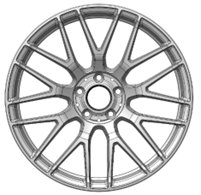
The proprietor, Mercedes-Benz Group AG, filed registered EU design no. 02351247-0009 on 25 November 2013 in the Locarno class 12-16 Wheels for Vehicles. The contested design has the following views:
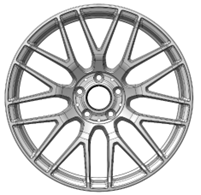
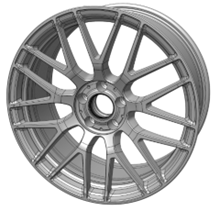
Registered EU Design No. 02351247-0009
The invalidity applicant, Jürgen Volkmer, filed an invalidity application arguing that the contested design was invalid because it had been disclosed to the public before the filing date and therefore was not new and did not have individual character.
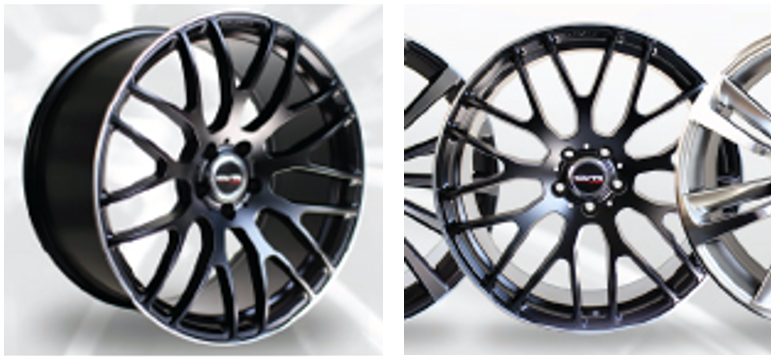
To support their invalidity application, the invalidity applicant filed screenshots of posts from an Instagram account dated 19 September 2012 showing a wheel both mounted to a vehicle and unmounted (designated as document UN2) and a screenshot from an automotive blog dated 6 April 2012 showing a range of wheel designs (designated as document UN3).
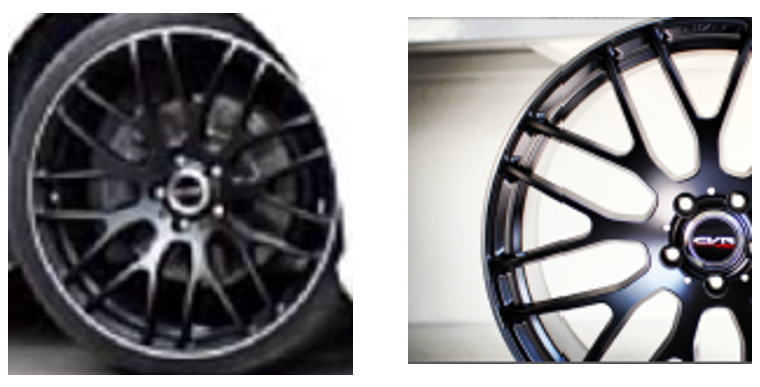
UN2
UN3
The proprietor disagreed and argued that this issue had already been dealt with in German regional courts and that the UN2 and UN3 are addressed to an extremely limited audience and consequently do not meet the threshold for public disclosure according to the EU Design Regulation. In other words, since the Instagram account and the blog are obscure, the prior designs should be deemed as undisclosed to the public.
Are the German regional court decisions relevant?
As part of their defence, the proprietor submitted a Judgement of the Stuttgart Higher Regional Court in which the Court said that the contested design stands out from the prior art.
However, as pointed out by the invalidity applicant, the German court system has bifurcated proceedings in which infringement and validity are considered separately, and this decision relates only to infringement, not to validity. As a result, the prior art was only considered when determining the scope of protection conferred by the design for infringement purposes. The validity of the contested design, including its novelty and individual character, were not addressed.
The Invalidity Division did not take the German regional court decisions into account in their decision.
Do UN2 and UN3 meet the threshold for disclosure under Article 7(1) EUDR?
Under EU design law a prior design is deemed to have been disclosed to the public if it was published, exhibited or used in trade “except where these events could not reasonably have become known in the normal course of business to the circles specialised in the sector concerned, operating within the Union” (Article 7(1) EUDR). This provides an exception for very obscure disclosures but in our experience this exception is difficult for a proprietor to prove, particularly for internet disclosures.
In this case, the proprietor argued that the UN2 and UN3 were internet publications having a very low level of dissemination and therefore it could not be assumed that they would have become known within the EU before the filing date of the contested design.
The Invalidity Division did not agree with the proprietor. The publication of a prior design on the internet is a disclosure within the meaning of Article 7(1) EUDR and the exception in Article 7(1) EUDR does not require actual awareness of the disclosure, only that awareness was reasonably possible in the normal course of business.
Consequently, the Invalidity Division decided that both UN2 and UN3 meet the threshold for disclosure and were made available to the public before the filing date of the contested design.
Does the contested design have individual character over UN2 and UN3?
Once it was decided that UN2 and UN3 were both valid prior disclosures the next step was to assess whether the contested design had individual character over UN2 and UN3.
The invalidity division applied the four-stage examination to assess individual character, namely:
- deciding on the sector that the products in which the design is intended to be incorporated or to which it is intended to be applied belong;
- deciding the informed user of those products in accordance with their purpose and, with reference to that informed user, the degree of awareness of the prior art and the level of attention in the comparison (direct if possible) of the designs;
- deciding the designer’s degree of freedom in developing their design;
- determining outcome of the comparison of the designs at issue, considering the sector in question, the designer’s degree of freedom and the overall impressions produced on the informed user by the contested design and by any earlier design that has been made available to the public.
Regarding point 3, the proprietor argued that the designer’s degree of freedom in developing the wheel design was very limited because the field of wheel designs is densely populated. The Invalidity Division did not agree, saying that the designer of a wheel for a vehicle has a high degree of freedom which is only limited by the need for the wheel rim to be circular. For other design features, the degree of freedom is almost unlimited.
The result of this decision is that small differences between the prior designs and the contested design would not be enough for the contested design to have individual character.
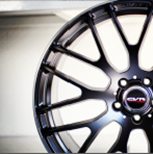
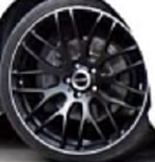
UN2
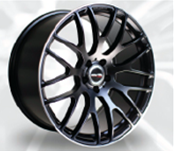
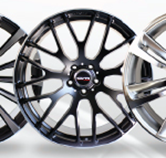
UN3
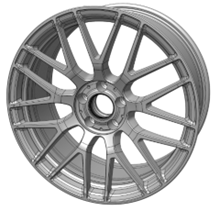
Contested Design
The Invalidity Division identified some minor differences between the contested design and the prior wheels designs, but also many similarities which include:
- The same overall form and proportions
- The same number of pairs of Y-shaped spokes
- U-shaped openings between the spokes
- Five large holes around the hub
- Five small holes between they large holes
- An overall light delicate appearance
It was noted that the prior designs are black in colour, while the contested design is silver. This is a point of difference. However, the Invalidity Division said that for designs that have the same shape and other features, a difference in colour is not sufficient to create a distinct overall impression on the informed user where the designer’s degree of freedom in developing the contested design was very broad.
The result was that the Invalidity Division declared the contested design to be invalid because it does not have individual character.
Take-away points
File early applications
- Registered designs are relatively inexpensive and quick to obtain in most countries.
- Filing for registered design protection early remains the most effective way to avoid invalidity challenges based on third-party disclosures. In many countries it is possible to defer publication of the design, for example in EU publication can be deferred for up to 30 months. Therefore, do not hold off filing your application just because you don’t want it to publish in the next few months. Deferred publication offers a simple and reliable way to secure a filing date while keeping the design confidential.
The “obscure disclosure” exception in the EU is very difficult to rely on
- Disclosures on the internet will be treated as public disclosures under Art 7(1) EUDR, even where the disclosure has a very small audience. The exception under Art 7(1) EUDR is applied very narrowly for internet disclosures in particular.
- Proprietors should assume that most internet publications will qualify as public disclosures for the assessment of novelty and individual character. As such, proprietors should be prepared to submit compelling and concrete evidence if they are attempting to rely on the obscure disclosure exception.
Keep careful records of disclosures and utilise grace period strategy
- Proprietors should ensure that registered designs are filed before any disclosures have been made, or if needed within any grace period that applies. This approach should be taken even if you believe a disclosure has not or will not be seen by a wide audience. As always, there are risk associated with relying on grace periods, so file early applications.
It can be difficult to prove a low degree of design freedom
- There can still be high degree of freedom in sectors with extensive prior art such as with wheels for vehicles.
- Arguments that a sector is saturated are unlikely to be successful without strong evidence showing constraints that genuinely limit design choices.
A difference in colour may not be helpful
- Differences in colour are unlikely to establish individual character where two designs have the same shape and other features.
National court findings are not that useful
- The EUIPO will conduct their own independent assessment on the validity of a registered design. Decisions of national courts may be of limited relevance to the EUIPO.
At Reddie & Grose LLP, we regularly assist companies and overseas counsel with European design protection and filing strategy. If you would like to discuss a European design matter, please get in touch.
This article is for general information only. Its content is not a statement of the law on any subject and does not constitute advice. Please contact Reddie & Grose LLP for advice before taking any action in reliance on it.