
27/10/2026
From the FIFA World Cup to the Tour de France and The Open, this summer’s biggest sporting events have pushed athletes and their equipment to the limit.
For decades, sporting equipment was designed primarily to be lighter, stronger and faster, with sustainability often taking a back seat. That is beginning to change, as manufacturers turn to recycled textiles, bio-based materials and more circular production methods without compromising elite performance.
So, how are the world’s biggest sporting events showcasing the next generation of sustainable materials, and what role is intellectual property playing in this transition? Let’s take a closer look.
Football: Keeping the Environment Onside
Hosted across the United States, Canada, and Mexico, the 2026 World Cup served as the launchpad for Nike’s new Aero-FIT technology, which debuted on the kits of several national teams including England, France, Brazil and the United States.
Aero-FIT marks a significant step towards circular sportswear as the kits are the first in World Cup history to be made from 100% textile waste, replacing the recycled plastic bottles used in previous generations of kit with fibres recovered through chemical recycling.
The Aero-FIT manufacturing process involves using solvents, heat and chemical agents to break down discarded polyester fibres into their monomers, which can be synthesised back into polymer chains and spun into polyester yarn that is almost indistinguishable from petroleum-derived virgin material [1]. This approach avoids the extraction and processing of fossil fuels required to produce virgin polyester and diverts textile waste away from landfills.
Sustainable materials innovation at the World Cup also extended beyond the shirt. Nottingham-based manufacturer Sokito produced bespoke Scudetta Kaizen boots for Norway midfielder Morten Thorsby using predominantly bio-based materials including sugarcane, plastic bottles, corn, castor beans and wood fibres [2].
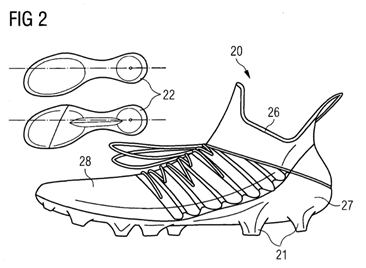
This shift is also reflected in the patent landscape. For example, EP 3 081 109 B1, granted to German sportswear giant adidas, describes sports shoes designed around a closed material cycle, in which material recovered from the shoes can be used to manufacture new footwear.
Cycling: Reinventing the Wheel
Few sporting events place greater demands on materials than the Tour de France. However, sustainability in cycling presents a different challenge as components such as tyres and helmets are safety-critical components that are regularly replaced.
At the 2026 Tour de France, Continental supplied more than 1,000 racing tyres to six teams, and is also developing ways to make bicycle tyres themselves more compatible with a circular economy. Its patent application EP 4 275 915 A1, “Bicycle tyres and methods for recycling bicycle tyres”, describes a bicycle tyre designed using specific rubber compositions to facilitate effective recycling. The invention specifically addresses the difficulty of recycling cross-linked rubber, with the aim of recovering more usable material from discarded bicycle tyres.
The same principle extends to helmets, where sustainability must be balanced against the stringent requirements of protective equipment. Helmets are traditionally manufactured from expanded polystyrene and polycarbonates, but manufacturers are considering bio-derived alternatives.
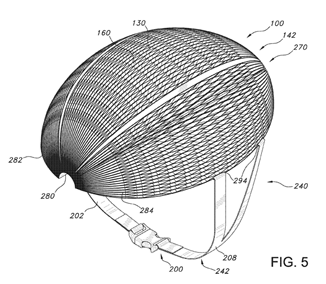
For example, EP 3 512 370 B1, in the name of Membrain Safety Solutions LLC, describes a bicycle helmet comprising a honeycomb matrix which may be made of materials including, recycled paper, corn, hemp, and other organic fibres. The invention also contemplates systems for returning used helmets to create a circular lifecycle.
Together, these developments show that replaceable equipment is increasingly becoming an area for material innovation, with patents providing an indication of how manufacturers are seeking to reduce waste while maintaining the requirements of elite competition.
Golf: Going for the Green
Sustainability was also on display at The Open in 2026, as the Championship returned to Royal Birkdale for the first time since 2017. The R&A’s Greenlinks programme has made sustainability an increasingly visible part of the event, with on-site emissions reduced by more than 93% and zero waste sent to landfill for the past five years. At Royal Birkdale, this approach extended to the products associated with the Championship, with Reflo producing an officially licensed “Living Links” collection of apparel made entirely from recycled materials and inspired by the natural landscape surrounding the course [4].
The opportunity for material innovation in golf, however, extends beyond clothing. Golf clubs are complex assemblies containing metals, polymers and other materials, making them an interesting target for recycled-material technologies. For example, EP 2 496 319 B1, granted to Nike, describes golf clubs and club heads incorporating recycled “regrind” material in the club head, ball-striking surface, and grip in an effort to reduce manufacturing waste and the consumption of virgin materials.
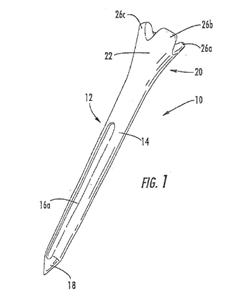
Perhaps the most straightforward example is the humble golf tee. Unlike a golf club, a tee is deliberately designed to be used at most a handful of times, meaning that even a relatively small material footprint can be multiplied across millions of rounds of golf. Patent activity has therefore explored alternative to conventional plastic and wooden tees. US 2018/272205 A1, in the name of Evolve Golf, describes a golf tee which may be made from a biodegradable polymer or a biocompostable material, with an exemplary material being a polylactic acid-based material with flax fibre as an impact modifier. The invention also considers the frictional properties of these materials, illustrating how sustainability can be incorporated into a product without losing sight of the performance demands of the game.
The Final Score
Whether a World Cup boot, a Tour de France tyre, or an Open golf club, this summer’s biggest sporting events have showcased not only the limits of human performance, but also the materials innovation behind it.
What is changing is not the pursuit of performance, but what it means to make sporting equipment better. Manufacturers are increasingly developing products that perform at the highest level while reducing reliance on virgin materials, incorporating recycled and bio-based inputs, and considering what happens at the end of their useful lives. The patent landscape reflects this shift, with innovation spanning new materials, manufacturing processes and technologies designed for greater circularity.
As elite sport continues to push boundaries, the world’s biggest events are becoming a proving ground for sustainable materials. The most successful innovations may ultimately be those that go unnoticed: products that perform seamlessly for athletes while quietly reducing their environmental impact.
This content is for general information only. Its content is not a statement of the law on any subject and does not constitute advice. Please contact Reddie & Grose LLP for advice before taking any action in reliance on it.
[1] Chemical Recycling: How Nike Made World Cup Kits from Waste | Procurement Magazine
[3] Continental Equips Six Tour de France Teams with Road Bike Tires | Continental[4] The Living Links: A limited edition collection made for The Open Championship at Royal Birkdale | Reflo