23/06/2026
Toy Story 5 hit cinemas in the UK and US on 19 June 2026, with a plot that pits technology against creativity. It’s a fitting theme for the present day, but also for Pixar’s own history. Long before Woody and Buzz became household names, Pixar was a struggling technology company that developed ground-breaking innovations which created both computer-animation and a patent portfolio that helped secure the company’s future.
Pixar’s Hardware Start
Pixar began life in 1979 as the Computer Division of George Lucas’s Lucasfilm, led by computer scientist Ed Catmull. In 1986, Steve Jobs purchased a majority stake for $10 million, acquiring both the team and the intellectual property it had developed, envisioning a hardware company that would use animated films to showcase their capabilities [1].
That vision struggled commercially. Pixar first released a specialised image-processing machine, the Pixar Image Computer, to very limited sales. The company subsequently released their Computer Animation Production System (CAPS), a combined hardware-and-software pipeline for digitally colouring animation frames. Whilst CAPS was licensed to Disney for use in their animated films from 1989 to 2004, it was not enough to make Pixar profitable. Through to the early 1990s, Pixar remained heavily dependent on Jobs’s financial support, who sunk around $50 million of his own money into the company [2].
What Pixar did possess was a growing reputation for its rendering software RenderMan. Already used to create acclaimed short films such as Luxo Jr. (1986) and Tin Toy (1988), RenderMan would later power visual effects in films such as Jurassic Park (1993), and of course act as the foundation for Toy Story (1995) [3]. Less obvious at the time, however, was the value of the intellectual property underpinning the software.
A REYE of Light
RenderMan was built on an underlying rendering architecture called REYES (“Renders Everything You Ever Saw”), developed within Lucasfilms’s Computer Division during the 1980s and further advanced at Pixar. REYES combined advances in programmable shading, geometric subdivision and image sampling to produce levels of realism not previously practical on the hardware of the time.
REYES divided rendering into multiple stages. Three-dimensional scenes were first subdivided into tiny surface elements known as “micropolygons”, typically smaller than a pixel. Programmable shaders calculated the appearance of these micropolygons, and the contributions of micropolygons at pseudo-randomly distributed sample locations throughout the scene were combined to reconstruct the final image [5].
The method of sampling was critical to rendering because poor sample selection can produce visual artefacts such as jagged edges and noise, known as aliasing. Pixar’s solution was reflected in their patent portfolio, which included a series of patents covering techniques for pseudo-random point sampling beginning with US Patent No. 4,897,806
The patent refers to sample distributions whose Fourier spectrum is substantially continuous rather than concentrated at a small number of frequencies. This replaced the repetitive noise of regular sampling with low-level noise that is less noticeable to the human eye. In practice, Pixar often employed Poisson-disk style sampling, an approach which maintains a minimum separation between neighbouring samples, modelled on the distribution of cells in the human retina [6].
Pixar recognised that the same sampling principle could be applied beyond anti-aliasing, with the patent also describing sampling over the duration of a camera shutter to simulate motion blur, and sampling over the aperture of a virtual lens to create a depth-of-field effect by blurring objects outside of the focal plane.
Pixar also applied pseudo-random sampling to create realistic lighting and shadows. Rather than evaluating every possible light path or reflection angle, REYES selected a single example from a range of possibilities at each sample point, which could then be averaged to approximate reflections, transparency, and soft shadows whilst minimising computational intensity [7].
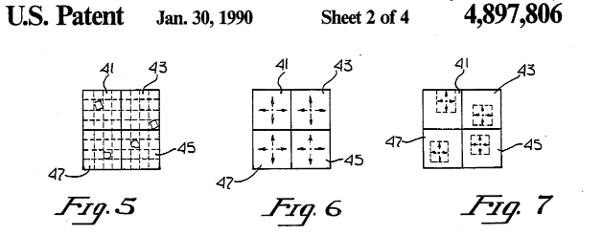
Drawings from US 4,897,806 A | PIXAR [8]
To Intellectual Property and Beyond
Although these techniques had been developed and refined within REYES, the patents beginning with US 4,897,806 were drafted to broadly claim the underlying mechanisms rather that any specific implementation. This meant Pixar had developed a patent portfolio with relevance to the entire industry of computer graphics, and in 1994, with Toy Story still in production and Pixar’s finances under pressure, these patents became a lifeline.
Initially, Jobs planned to sue infringers of their patents relating to pseudo-random point sampling for $50 million. However, CFO Lawrence Levy advocated instead for licensing the technology to Microsoft and Silicon Graphics (SGI) for use in their own graphics products.
The strategy proved highly successful. Within 3-months Microsoft had agreed a non-exclusive license for $6.5 million, and within a year SGI followed with a deal worth $6 million in cash and a further $5 million in hardware and software credits [9] [10].
The agreements provided a rapid injection of capital without the cost, uncertainty and distraction of litigation, and more importantly, helped sustain Pixar during the production and distribution of Toy Story. When the film was released in November 1995, it became both a critical and commercial triumph, securing the future of Pixar and helping establish computer-generated animation as a mainstream medium.
What Can We Learn?
As Woody and Buzz return for a fifth outing, it’s easy to forget that Pixar began not as an animation studio, but as a struggling technology company searching for a viable business model.
For inventors, Pixar’s experience demonstrates the value of protecting not only a finished product, but also the underlying technical principles. The company’s sampling patents were valuable precisely because they were not confined to RenderMan and were instead applicable across an entire industry.
The story also highlights that the value of a patent lies not only in the right to exclude competitors but also in providing strategic opportunities for licensing, partnership and revenue generation. In Pixar’s case, that flexibility helped bridge the gap between a struggling technology company and one of the most successful animation studios in the world.
This content is for general information only. Its content is not a statement of the law on any subject and does not constitute advice. Please contact Reddie & Grose LLP for advice before taking any action in reliance on it.
[2] The Real Story of Pixar | IEEE Spectrum
[3] The Evolution of RenderMan® | PIXAR
[4] The Story Behind Pixar’s RenderMan CGI Software | IEEE Spectrum
[5] (n 4)
[6] (n 4)
[7] R. Cook, T.K. Porter, L.C. Carpenter, “Pseudo-random point sampling techniques in computer graphics”, U.S. Patent 4,897,806, Jan. 30, 1990
[8] (n 7)