
08/12/2025
Different IP rights can sometimes overlap. A recent EUIPO invalidity decision provides a useful reminder that decorative elements of a product design can cross into trade mark territory, and when they do, conflict may arise.
Background
The proprietor, Road Star Group, filed registered EU design no. 004160273-0002 on 23 August 2017 in the Locarno class 02-04 Footwear. The contested design has the following views:
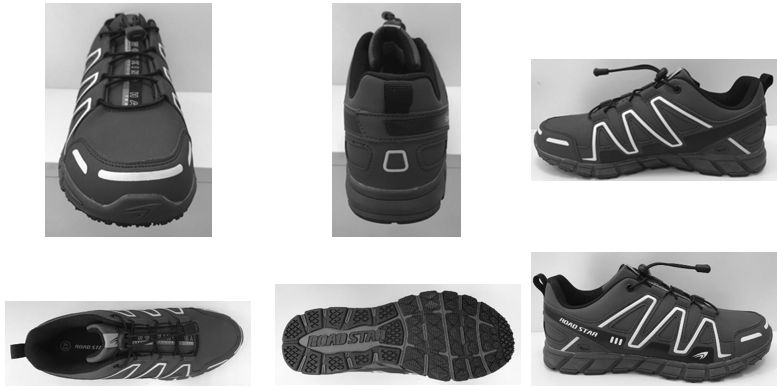
Registered EU Design No. 004160273-0002
The invalidity applicant, Salomon SAS, filed an invalidity application arguing that the contested design was invalid on various grounds, including that the contested design used a sign identical to the invalidity applicants registered EU trade mark no. 011655727 (Article 25(1)(e) EUDR).
What does Article 25(1)(e) EUDR say and how does it apply?
Article 25(1)(e) EUDR defines that an EU design may be declared invalid if:
“a distinctive sign is used in a subsequent design, and Union law or the law of the Member State governing that sign confers on the right holder of the sign the right to prohibit such use”.
In other words, if a registered EU design contains an earlier EU trade mark or an earlier trade mark under the national law of one of the EU Member States, then the design may be declared invalid.
Article 25(1)(e) EUDR therefore allows the owner of the earlier trade mark to prevent the use of a subsequent EU design that includes a sign identical to the earlier trade mark, where the good and services covered by the design are identical to those covered by the earlier trade mark.
The owner of the earlier trade mark also has the right to prevent the use of a subsequent EU registered design where:
- the subsequent registered design includes a sign that is similar to the earlier trade mark;
- the goods or services covered by the earlier trade mark are identical or similar to those covered by the subsequent registered design; and
- there is a likelihood of confusion on the part of the public.
The earlier trade mark
The invalidity applicant’s earlier EU trade mark is the figurative mark shown below:
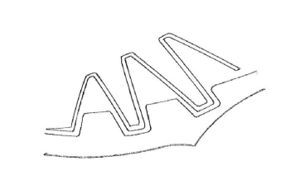
Registered EU Trade Mark No. 011655727
The earlier trade mark was registered on 14 March 2013 in Class 25 for goods including footwear.
1. Does the subsequent contested design include a sign that is similar to the earlier trade mark?
The first step for the Invalidity Division was to determine whether the contested design included a sign that is at least similar to the earlier trade mark.
The Invalidity Division decided that the average footwear consumer is reasonably well informed, reasonably observant and circumspect, and has an average degree of attention.
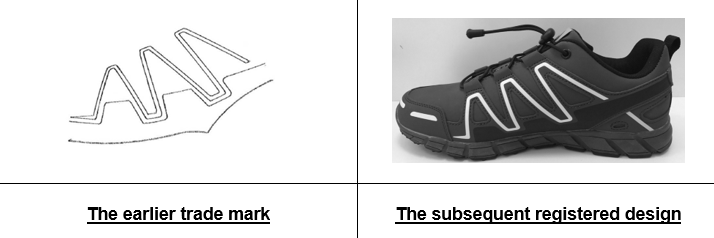
According to the Invalidity Division, the earlier trade mark includes “a double polyline alternating upward and downward and producing a repetitive zigzag profile with three angular peaks”. Beneath this are two thin lines which form top and bottom edges of a thick band. An upper line depicts “a zigzag polyline with three square-like peaks”. A lower line forms “a concaved curve”.
The proprietor of the registered design argued that a zigzag line is commonly used by footwear manufacturers and therefore possesses a very low degree of distinctiveness, so every small difference must be taken into account. The Invalidity Division did not agree, saying that the earlier trade mark is not a simple geometric formation or a simple design, and so it has an average degree of distinctive character.
The invalidity applicant argued that the earlier trade mark is identical to the subsequent registered design. The proprietor did not agree and argued that there are differences, particularly in the right most line of the zigzag formations.
The Invalidity Division said the earlier trade mark and the sign used in the contested registered design both have a similar composition and stylisation, and the differences between the two are simply “small differences in the angles or roundness of corners” which “are not striking or significant when compared with the similarities in the overall compositions of both signs”.
As a result, the Invalidity Division decided that the earlier trade mark and the sign used in the contested design are visually similar.
2. Are the goods covered by the earlier trade mark identical or similar to those covered by the contested registered design?
The second step for the Invalidity Division was to determine whether the goods and services covered by the earlier trade mark were identical to the goods to which the registered design is intended to be applied.
The earlier trade mark is registered in Class 25 for footwear. The contested design was registered in Locarno Class 02-04 for footwear and clearly shows a shoe.
Consequently, the Invalidity Division found that the contested design is intended to be used in relation to goods which are identical to the goods covered by the earlier trade mark.
3. Is there a likelihood of confusion on the part of the public?
The third step for the Invalidity Division was to determine whether there is a likelihood of confusion on the part of the public. Would the public be led to believe that goods to which the contested design is intended to be applied (footwear), and goods covered by the earlier trade mark (also footwear), both come from the same undertaking?
The earlier trade mark and the subsequent contested registered design:
- both concern identical goods (footwear)
- target the public at large, who have an average degree of attention
- are visually similar to one another
As mentioned above, the earlier trade mark and the sign used in the contested design are not identical. There are some differences, particularly in the right most line of the zigzag formations.
However, the Invalidity Division explained that the relevant consumers “may not recall the exact inclination angles and lengths of the angular zigzag lines or sharpness of their corners” and instead their attention would be attracted to the overall composition of both signs, which show two very similar zigzags arranged in the same manner.
The Invalidity Division said that “it is highly conceivable that the relevant consumers, with an average degree of attention, may perceive the sign used in the contested design as a variation, or slightly amended version, of the earlier trade mark when encountering the signs in the context of identical goods/products”. The average consumer may therefore be led to believe that footwear according to the contested design and footwear having the earlier trade mark come from the same undertaking or from economically linked undertakings.
A likelihood of confusion arises “where the consumer directly confuses the signs themselves, or where the consumer makes a connection between the conflicting signs and assumes that the goods/services covered are from the same or economically linked undertakings”.
Consequently, the Invalidity Division found that there is a likelihood of confusion.
The verdict
In summary, the Invalidity Division found that:
- the contested registered design includes a sign that is visually similar to the earlier trade mark,
- the goods covered by the earlier trade mark are identical to those to which the contested registered design is intended to be applied, and
- there is a likelihood of confusion on the part of the public
Consequently, the Invalidity Division held that the facts and evidence submitted by the invalidity applicant supported the ground for invalidity under Article 25(1)(e) EUDR. Therefore, the contested design was declared invalid.
Take-away points
For a registered trade mark owner:
- Keep an eye on the designs register to check whether third parties are registering designs which include signs corresponding to your registered trade marks.
- Article 25(1)(e) EUDR can be a very useful and powerful tool if you identify a registered design which incorporates a sign that is the same or similar your registered trade mark.
- Consider filing registered trade marks to protect broader aspects of your design language, so that you can use them as the basis of an Article 25(1)(e) EUDR attack.
For a registered design applicant:
- Know that Article 25(1)(e) EUDR exists and can be used against you if your design includes a sign that looks the same or similar to an existing registered trade mark.
- If carrying out prior art searches, include trade mark registers, not just design registers.
- Be wary of filing only a single design to protect a product. If your one design is invalidated then you will no longer have any registered design protection for your product.
- Take care when deciding the appropriate Locarno class. While non-limiting on scope of protection, it may influence assessments of similarity of goods, as illustrated in this case. It would be interesting to see how this point would have been decided if Road Star Group had applied for a graphic symbol, or for said pattern on a different product outside of footwear.
This article is for general information only. Its content is not a statement of the law on any subject and does not constitute advice. Please contact Reddie & Grose LLP for advice before taking any action in reliance on it.