
26/08/2025
Invalidating a registered EU design for a lack of novelty is very difficult. A recent decision by the EUIPO’s Board of Appeal in HSM Schuhmarketing GmbH v Crocs, Inc. (R 114/2025-3) provides us with insight into how novelty is assessed at the EUIPO for a design which includes a visual disclaimer.
In this case Crocs succeeded in defending a registered design protecting one of their famous clog designs when challenged by HSM using prior designs including Amazon product listings.
The decision reinforces that even small design differences can be enough to confer novelty over a prior design. The case also touches on the use of Amazon product listings as prior art and the importance of properly substantiating arguments when making a lack of individual character attack.
A summary of the case is set out below.
Background
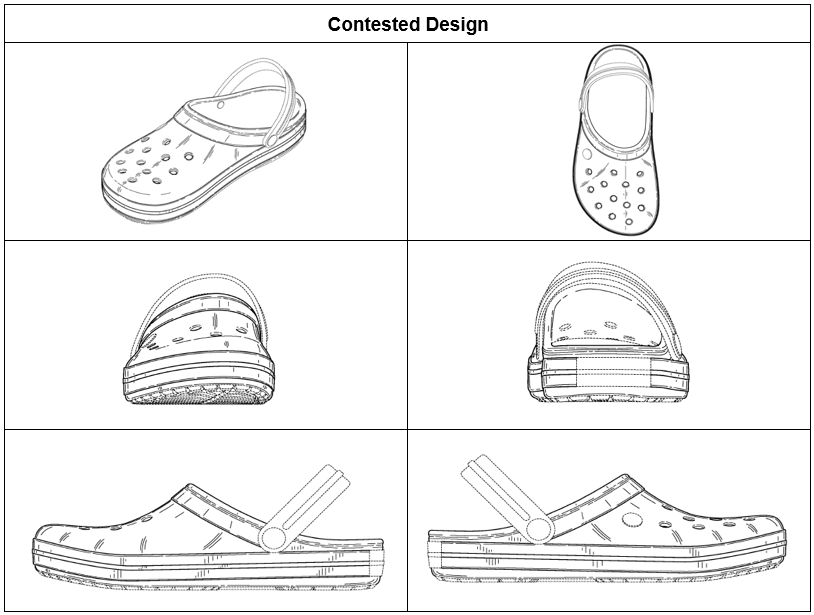
The appeal was against an earlier invalidity decision issued on Crocs’ registered European Union design (REUD) no. 001626300-0001, which has a filing date of 21 October 2009.
The application for a declaration of invalidity
In November 2023, HSM filed an application for a declaration of invalidity of the REUD, claiming that the contested design lacks both novelty and individual character.
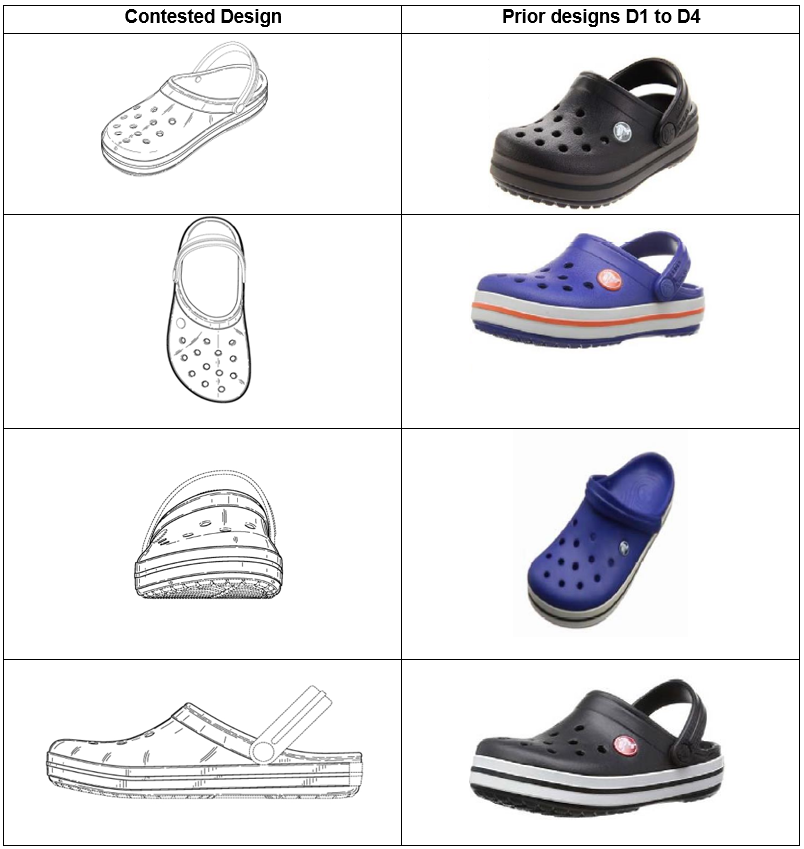
HSM argued that Crocs’ REUD lacks novelty over shoes which had been offered for sale on Amazon before its filing date. Evidence was submitted relating to four prior designs listed on Amazon (D1-D4). The evidence included the Amazon Standard Identification Number (ASIN), a printout of the offer on Amazon, and the first availability date of each of the four shoe designs.
HSM also argued that Crocs’ REUD lacks individual character, broadly claiming that “a considerable number” of prior designs produced a similar overall impression to Crocs’ REUD. In support of this argument, HSM submitted a list of 111 earlier registered EU designs.
Crocs argued that the disclosure of D1-D4 had not been proven because the dates associated with the Amazon product listings could have been modified and were therefore unreliable. On individual character, Crocs highlighted that no reasoning had been provided by the applicant as to why the contested REUD would produce the same overall impression as any of the 111 individual registered designs submitted in the list.
In November 2024, the Invalidity Division rejected the application for a declaration of invalidity.
In their decision the Invalidity Division noted that, according to the General Court, evidence of disclosure of a product in an online retail shop has sufficient probative value and therefore the designs of D1-D4 were considered to have been made available to the public.
Nonetheless, the Invalidity Division concluded that while the designs of D1-D4 have a similar overall shape to the contested design, none of them were identical to Crocs’ REUD and so the contested design is novel. This is partly because the shoe designs in D1-D4 all show a heel strap, while in the contested design the heel strap is disclaimed.
For individual character, since HSM had failed to comment separately on each invoked prior design in the long list of 111 prior designs, the Invalidity Division decided that the evidence should be disregarded. Consequently the individual character attack was rejected.
The appeal
HSM disagreed with the Invalidity Division and filed an appeal. HSM argued that the heel strap in D1-D4 is an insignificant detail and so the contested design does lack novelty over D1-D4. HSM also maintained their position that the contested design lacks individual character over the long list of 111 prior designs.
In response, the design owner Crocs argued that the disclosure of D1-D4 has not been proven. Crocs submitted witness statements explaining that the particular shoe model shown in D1-D4 was designed in 2009 and released to the public after the filing date of 21 October 2009. Crocs also argued that an ASIN on its own is not suitable as evidence because it is not reliable.
The decision
The Board ruled in favour of Crocs and rejected claims that the contested design lacks novelty or individual character.
Disclosure of the Amazon product listings (D1-D4)
For reasons of procedural economy, the Board did not assess the arguments concerning whether D1-D4 had been disclosed to the public before the filing date of the contested design.
Novelty over D1-D4
A registered EU design has novelty over an earlier design if it differs from the earlier design by more than immaterial details.
The point of reference when examining novelty is the contested design. In this case, the contested design was filed with colourless line drawings and disclaimed the strap. Consequently, the Board decided that the colour and the strap in D1-D4 are to be disregarded in the comparison for novelty. This is a different interpretation to the Invalidity Division, which identified the absence of a strap in the contested design as a distinguishing feature.
Despite this, the Board still found the contested design to be sufficiently different to D1-D4, noting it differs in the shape and orientation of the upper cover in particular. Additionally, D1-D4 all depict a left shoe, while Crocs’ REUD shows a right shoe, as well as additional views such as the rear and side portions. The Board states that it would be speculative to presume that the counterpart right shoe of any of D1-D4 would mirror the features shown in D1-D4.
The Board said that these differences could not be considered to be immaterial, and so Crocs’ REUD is novel over D1-D4.
Individual character over the list of prior designs
The Board endorsed the finding of the Invalidity Division, which said they were unable to assess the alleged lack of individual character because HSM failed to identify which of the 111 designs were invoked as prior designs.
R&G Comments
The date of disclosure of an Amazon product listing continues to be an issue at the EUIPO. It is unfortunate that the Board did not comment further on this aspect.
- An Amazon product listing is assigned an Amazon Standard Identification Number (ASIN) and a “Date first available” when the listing is first created. The EUIPO tends to take the “Date first available” as the date of disclosure for what is shown in the images. However, some parties argue that the images associated with the product listing can be altered after the product listing is made, and so the “Date first available” on its own is unreliable as evidence for disclosure.
- When relying on an Amazon product listing as prior art, consider using supplementary evidence which supports and verifies the “Date first available”, such as photos from product reviews.
- If an Amazon product listing is cited as prior art against you, consider if there is any evidence available which could show that the “Date first available” is not as claimed, or is at least unreliable.
This decision reiterates that the contested design is the sole point of reference when assessing novelty and individual character.
Lack of novelty and lack of individual character attacks can and should go together. In this case, it is unclear why the invalidity applicant did not also raise lack of individual character attacks based on D1-D4. Indeed, the Board even hints that the decision may have been different if these attacks had been raised- “It cannot be excluded that the assessment may have led to a different outcome had the ground for invalidity based on lack of individual character under Article 6 EUDR been invoked”.
When arguing for a lack of individual character, it is essential for the invalidity applicant to identify, reproduce, and comment on each earlier design relied upon. Otherwise, there is a risk that, like in this case, the attack is disregarded.
At Reddie & Grose LLP, we have extensive experience of protecting designs and advising on IP strategy. Please feel free to get in contact.
This article is for general information only. Its content is not a statement of the law on any subject and does not constitute advice. Please contact Reddie & Grose LLP for advice before taking any action in reliance on it.